Research Highlights · Cold-event attribution
Record cold in a record-warm year: eastern China in December 2023
Overview
This study examines the record-breaking cold spell in eastern China in December 2023, a striking event in what was then the warmest year on record globally. Exceptional large-scale circulation drove the event itself, while human-induced climate change made similar cold spells less likely and less severe overall. CMIP6 analysis shows that human influence slightly strengthened the circulation favourable for cold weather, but this cooling effect was much smaller than the warming of the climate background. Similar cold spells are projected to decline with continued warming; under low emissions, that decline slows and later partly reverses as global warming levels off.
Background
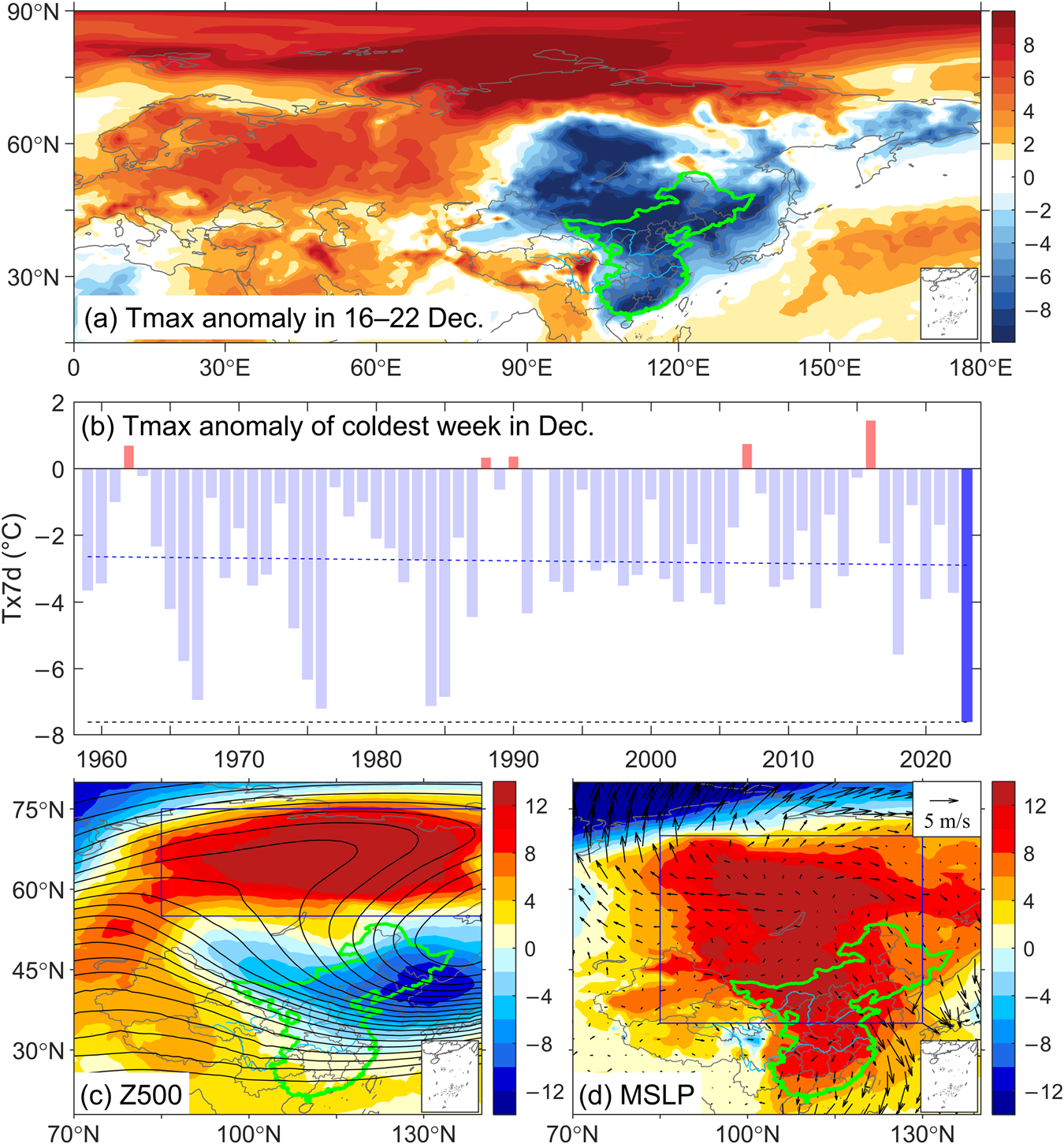
In 2023, the world experienced its warmest year on record at the time, yet December brought a memorable cold spell to eastern China. During 16–22 December, the regional mean daily maximum temperature anomaly reached about −7.6°C, making it the coldest December week since 1959. Meanwhile, the Arctic was unusually warm, producing a pronounced “Warm Arctic–Cold Eurasia” temperature pattern.
This pairing of warmth and cold has long attracted attention in climate research. Some studies suggest that rapid Arctic warming can alter mid- to high-latitude circulation, helping blocking highs persist and creating favourable conditions for cold air to move south. The 2023 event featured a warm Arctic, persistent blocking near Lake Baikal and an exceptionally strong Siberian High, a combination that naturally brings this explanation to mind.
Event attribution studies, including earlier work on Eurasia and eastern China, have generally found that human-induced warming makes extreme cold less frequent and less severe. We wanted to examine both aspects together: how exceptional circulation produced this particular cold spell, and how human-induced climate change altered the probability and intensity of similar events.
Methods
We measured the event using the regional mean daily maximum temperature anomaly during the coldest week of each December, an index called Tx7d. We first averaged daily maximum temperature anomalies relative to the corresponding days in 1961–1990 across eastern China, then selected the lowest running seven-day mean in December. This captures both the geographical coverage and the week-long duration of the cold.
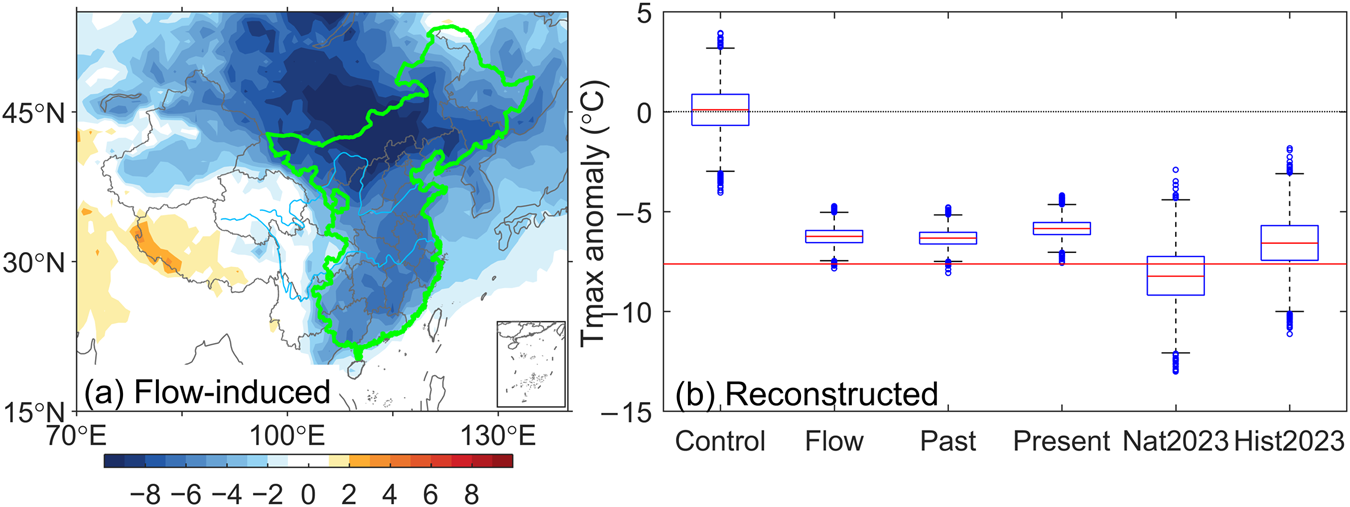
The storyline analysis began with the event itself. Using constructed flow analogues (CFA), we combined historical weather patterns with suitable weights to reconstruct circulation close to that of 2023, then applied the same weights to reconstruct temperature. We first estimated how much cold the circulation explained. Holding similar circulation in place, we then compared past and more recent climates in ERA5, and climates with and without human influence in HadGEM3, to estimate the effect of background warming.
The probability-based analysis treated the event as one member of a class of cold spells. Using nine CMIP6 models, we compared simulations including human influence with natural-forcing-only simulations to estimate how often events reached the 2023 severity and how cold an equally rare event would be. We also separated the dynamic and thermodynamic effects of human influence. Future projections used the 2023 climate as the baseline, with 21-year windows representing each period: 2013–2033 for 2023, for example, and 2080–2100 for the end of the century.
Results
Persistent blocking near Lake Baikal, together with a strong Siberian High at lower levels, continually transported cold air into eastern China. CFA reconstruction showed that this large-scale circulation explained about 83% of the event’s intensity, corresponding to a temperature anomaly of about −6.3°C. It was the main direct driver of the record cold.
Placing similar circulation in different climate backgrounds revealed warming acting in the opposite direction. In ERA5, temperatures associated with similar circulation were about 0.5°C higher in 1985–2022 than in 1959–1984. Comparing HadGEM3 simulations with and without anthropogenic forcing gave a warming contribution of about 1.7°C. These comparisons use different reference climates, but both show the same balance: while the circulation pulled temperatures down, a warmer background held them up.
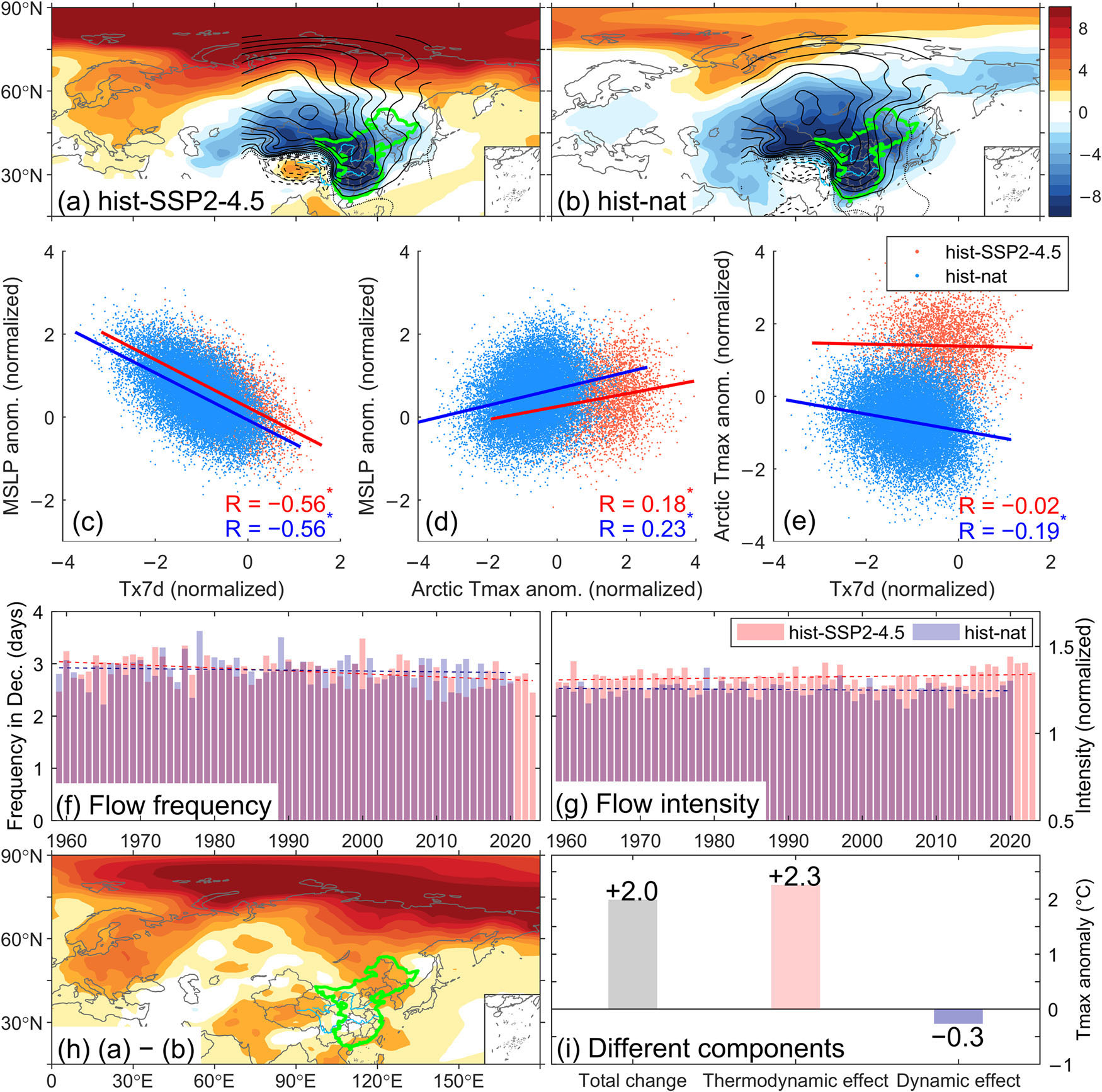
For the broader class of events, the CMIP6 ensemble gave a clear result. In the 2023 climate, human-induced climate change reduced the probability of similar cold spells by about 93% and made equally rare events about 1.9°C less cold, relative to a climate without human influence. The exceptional circulation in December 2023 was still strong enough to produce record cold, even though the climate background had made such events much harder to reach.
The models also allowed us to examine the links between Arctic warmth, cold in eastern China and circulation. Similar cold spells were accompanied by a Siberian High and a warm Arctic in simulations both with and without anthropogenic forcing. A stronger Siberian High generally coincided with colder eastern China and a warmer Arctic in both climates, showing that this weather configuration could also develop without human influence.
The direct relationship between the two regions’ temperatures changed more substantially. Under natural forcing only, a warmer Arctic tended to coincide with colder eastern China. With anthropogenic forcing, this negative correlation almost disappeared, while the link between the Siberian High and cold in eastern China remained stable. Warming altered the temperature background, making circulation a more useful connection to follow when interpreting these events.
Human-induced climate change did not significantly increase the frequency of these Siberian High patterns, but it strengthened them by about 6%, providing a dynamic influence towards colder conditions. The size of this influence was small compared with background warming. Decomposing the temperature difference between similar cold events in the model climates gave about +2.3°C from thermodynamic warming and −0.3°C from dynamic cooling, adding up to a net change of about +2.0°C. Stronger circulation offset a small part of the warming, while the thermodynamic effect dominated.
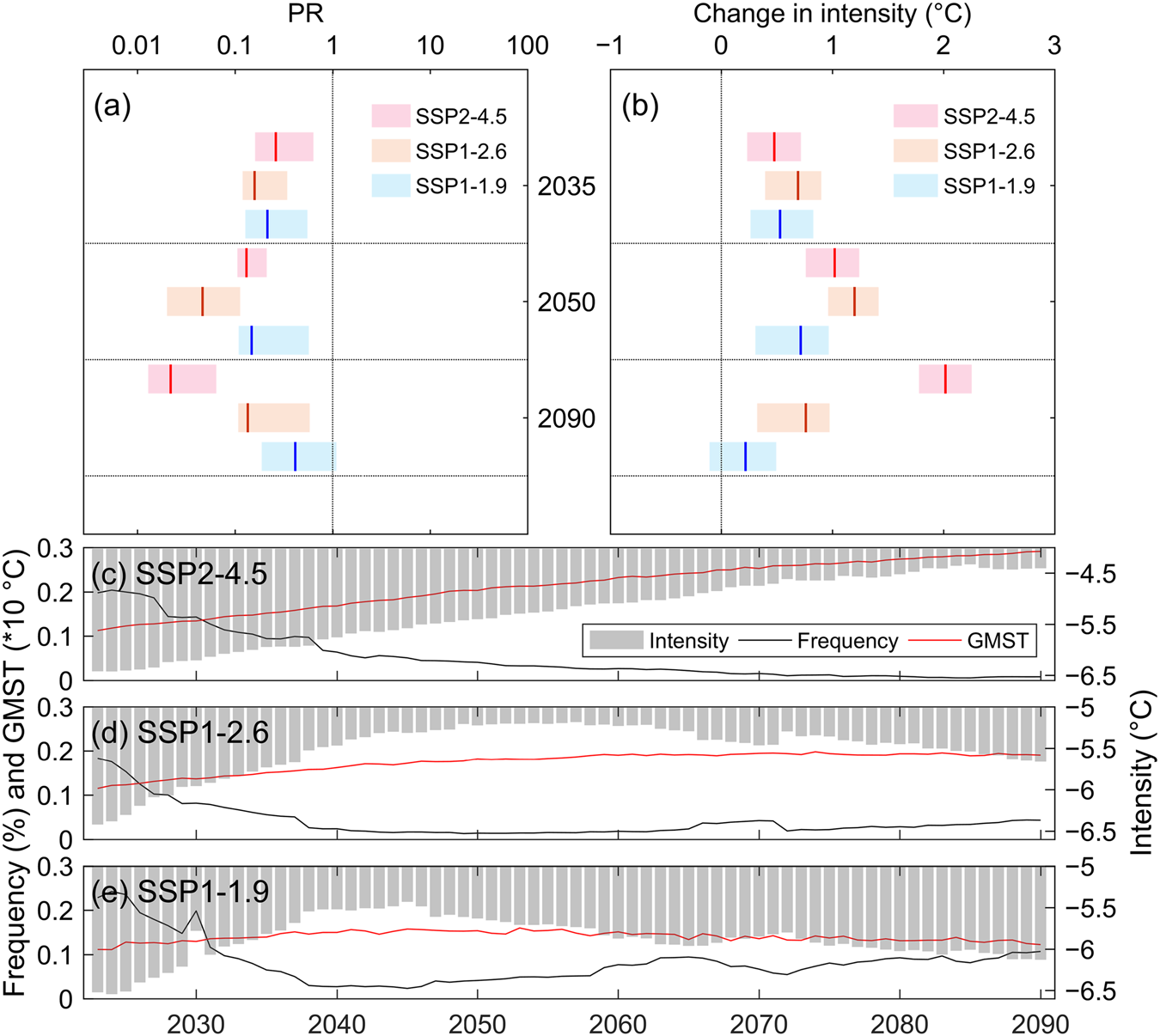
Future changes depend on how far warming continues. Under the intermediate-emissions SSP2-4.5 pathway, similar cold spells continue to become less likely and less severe. Toward the end of the century, their probability is projected to fall by a further 96% relative to the 2023 climate, while equally rare events become about 2.0°C less cold.
Low-emissions pathways show a different late-century evolution. As emissions fall and global warming levels off, the warming that keeps suppressing cold events weakens, and simulated cold spells begin to recover from their lowest levels. This turnaround occurs around 2060 under SSP1-2.6 and the mid-2040s under SSP1-1.9. By the end of the century under SSP1-1.9, neither the reduction in probability nor the reduction in cold severity relative to 2023 is statistically significant. Even in a future where warming has been brought under control, similar cold spells remain weather we need to prepare for.
Discussion
Together, the storyline and probability results make the December 2023 event easier to understand. Strong circulation explains why this particular week was so cold; background warming kept the same weather conditions from being colder still and reduced the chance of comparable events. A record-breaking cold spell can occur alongside a long-term decline in extreme cold, and examining both the event’s formation and its changing probability helps explain that apparently surprising combination.
The Warm Arctic–Cold Eurasia discussion also benefits from this framework. Temperature relationships between regions can change with the climate background, whereas the circulation–cold relationship was more stable in this study. Human influence strengthened the relevant circulation but raised temperatures much more strongly, with the final response reflecting both effects. How the exceptionally strong circulation and Arctic warmth developed in this particular event remains a question for further work.
Once global warming levels off, atmospheric circulation and internal climate variability can still produce severe cold spells. Heating, electricity, transport and agricultural systems therefore need to retain the capacity to cope with extreme low temperatures. Considering these practical adaptation needs alongside emissions goals will help societies prepare for a world that is warmer on average but still experiences bitter cold.
Behind the scenes
This work began as a rapid attribution assessment at the end of 2023, another application of our rapid attribution system. During the winter break, I added the storyline analysis and took an initial look at the CMIP6 simulations, hoping to make the combination of storyline and probability-based attribution a central part of the paper.
The submission process was difficult, and we eventually submitted to npj Climate and Atmospheric Science in June 2024. One reviewer recommended rejection with resubmission, while the other recommended major revisions and raised many questions. The editor gave us a major revision. I really valued that opportunity and spent almost the entire summer working through the reviewers’ questions.
One task was to obtain additional CMIP6 circulation data, but our server had little storage left, so I had to put the data on an external drive. Processing was painfully slow, and the repeated waiting and analysis wore me down. Fortunately, both reviewers responded very positively after one round of revisions, and I was delighted when the paper was accepted. Working through that revision also helped me clarify what storyline and probability-based attribution each answer, and how to present them together. That proved especially useful when I later wrote my doctoral thesis.
I would also like to thank my junior colleagues Jiacheng Jiang and Yuting Zhang, who helped collect reports of the event’s impacts and news coverage early in the project.